
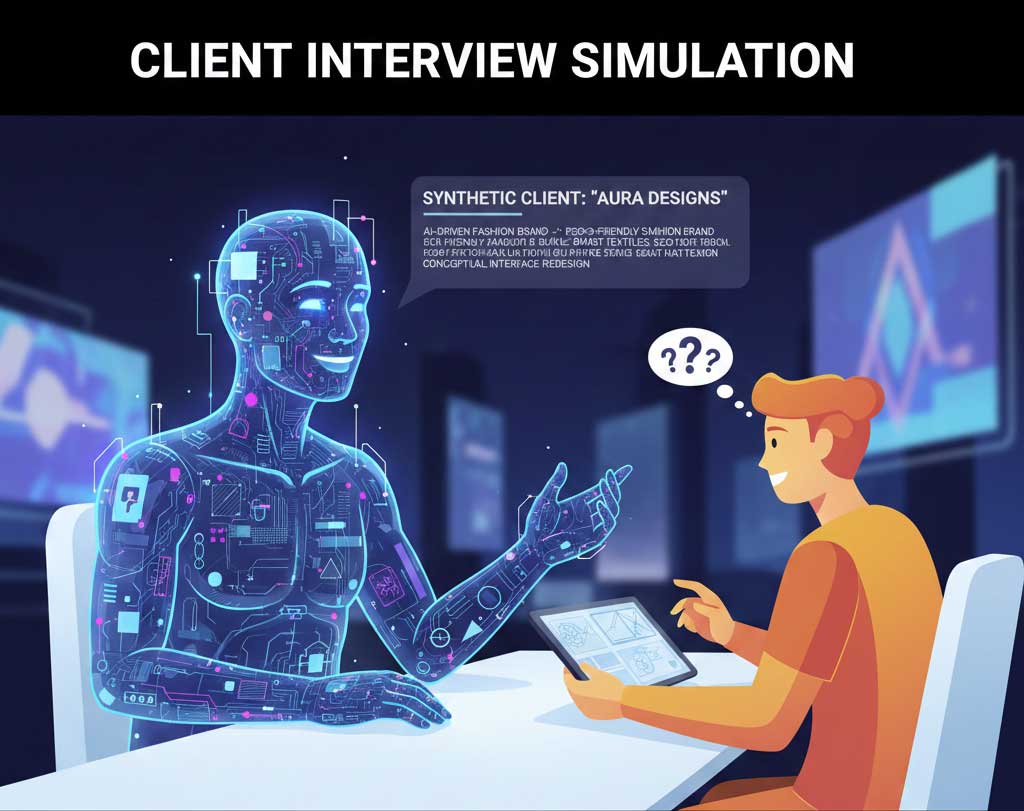
One of the hardest skills to teach in graphic design education is not software, aesthetics, or production. It is client discovery—the ability to ask the right questions before deciding what to design.
Students are often eager to jump straight to solutions. In practice, however, professional designers spend significant time navigating ambiguity, unclear requests, and clients who know their business well but do not know design. To better simulate this reality, this project introduces a synthetic client powered by AI.
The synthetic client is not a brief generator or a rubric disguised as a conversation. It is intentionally constrained to behave like a real business owner. The client understands their industry, their frustrations, and their goals, but does not speak fluent design language. Information is revealed only when students ask thoughtful, well-structured questions.
This design forces students to slow down. They cannot shortcut the process by asking what the final deliverables should be. They must conduct discovery, interpret signals, and translate business problems into appropriate design recommendations.
The Synthetic Client Prompt
At the core of the project is a carefully written system prompt that instructs the AI to remain in character at all times. The synthetic client:
-
Speaks in everyday business language
-
Avoids naming design deliverables unless they are explained first
-
Refuses to bypass the natural discovery process
-
Responds realistically to vague or leading questions
-
Pushes back on ideas that feel unnecessary, confusing, or too expensive
The client does not optimize for student success. It optimizes for its own business needs. This distinction is critical. Students must earn clarity through questioning, not extraction.
To further mirror real-world conditions, the client may offer opinions that reflect poor design taste—such as cluttered visuals, aggressive styles, or copying competitors directly. Students are expected to push back respectfully and justify their recommendations using business reasoning, audience needs, and design principles rather than personal preference.
Project Overview
In the current version of the project, students work with a 45-year-old plumbing business owner in Atlanta, Georgia. He operates four service vans, employs six people, and has deep experience in his trade. He believes he needs a logo, business cards, a website, and social media ads—but is unsure what should come first or why.
This uncertainty is intentional.
The student’s role is to lead the conversation, clarify priorities, and determine what design effort is actually appropriate. The project is adaptable by design. The industry, business size, and client personality can easily be swapped while keeping the same learning objectives intact.
The synthetic client can also upload visuals—photos, references, competitor examples, or rough ideas—giving students realistic material to interpret rather than blindly execute.
What Students Produce
Rather than jumping straight to polished design artifacts, students submit:
-
A discovery summary synthesizing what they learned
-
A justified design scope and prioritization
-
Documented examples of professional pushback
-
Clear reasoning that connects design decisions to business outcomes
Visual work may be included only when explicitly required.
Why This Matters
This project shifts assessment away from polish and toward judgment. It teaches students how to listen, question, explain, and advocate—skills that AI cannot replace and that employers consistently value.
By using a synthetic client, students experience the messiness of real client relationships in a controlled, teachable environment—one that rewards thinking, not shortcuts.
See the Full Project Description and Master Prompt used to create the Synthetic Client here.