
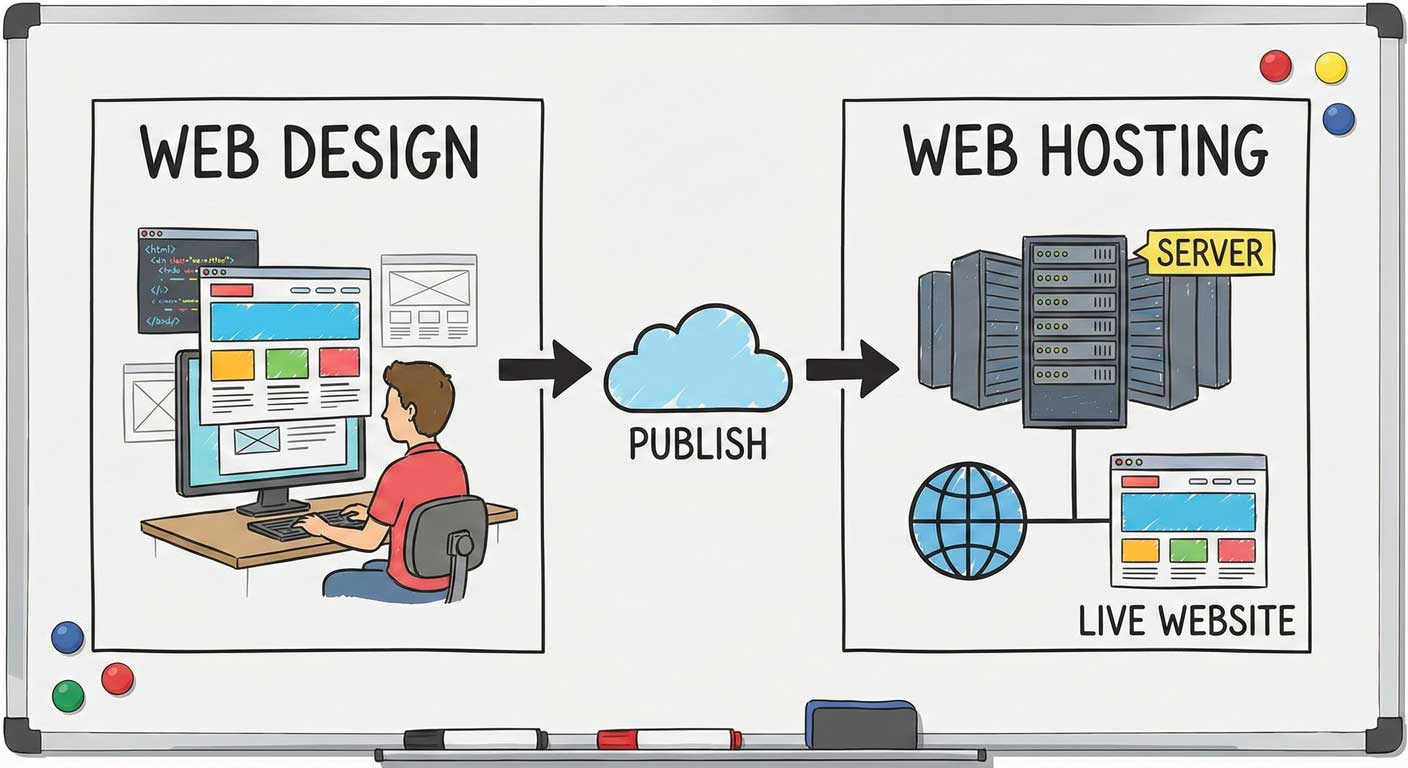
Web design education often prioritizes visual systems, interaction patterns, and user experience. These are essential skills. Yet beneath every successful website lies an invisible layer that is rarely addressed in design curricula: hosting infrastructure. My experience teaching web design has shown that a working knowledge of domains, servers, caching, and hosting environments is not supplemental—it is foundational. This literacy has quietly become one of the most impactful skills I pass on to students, even though it is often overlooked in academic design contexts.
Design students are frequently taught to think of the web as a canvas. In practice, the web is a system. A domain must be registered, pointed, propagated, and renewed. A server must be configured, secured, updated, and optimized. A website does not simply “go live”; it is deployed into an environment that either supports or undermines its performance, accessibility, and longevity. When students lack this understanding, their design decisions are abstract. When they have it, their decisions become grounded and professional.
One of the earliest points of failure for new designers is misunderstanding how domains work. Students often treat domains as branding artifacts rather than technical identifiers. Teaching how DNS records function—how A records, nameservers, and propagation delays affect visibility—changes how students plan launches, client timelines, and even naming strategies. This knowledge reduces confusion, anxiety, and costly mistakes, while reinforcing that design decisions operate within real technical constraints.
Server literacy further reshapes how students think about performance and responsibility. Understanding shared hosting versus VPS environments, server locations, and basic security practices reframes speed and reliability as design outcomes, not accidents. Students begin to see load time, uptime, and scalability as part of user experience rather than separate engineering concerns. This mindset shift alone produces more thoughtful, restrained, and effective design work.
Caching is another concept that quietly transforms student behavior. Once students understand browser caching, server-side caching, and content delivery networks, they stop treating websites as static compositions. They begin designing with update cycles, content strategy, and maintenance in mind. More importantly, they learn to debug. When a change does not appear, they no longer panic—they investigate. This is a critical professional habit that traditional design instruction rarely cultivates.
Plugin ecosystems, particularly in platforms like WordPress, offer a practical lesson in systems thinking. Students quickly learn that every plugin is a tradeoff: convenience versus performance, features versus security. Teaching students to evaluate plugins critically—rather than stacking them indiscriminately—mirrors real-world decision-making in agencies and in-house teams. It also reinforces ethical responsibility, as poor technical decisions can directly affect client businesses and users.
The relevance of hosting literacy has intensified with the rise of AI-driven systems. Tools such as ChatGPT, Gemini, and search engine crawlers increasingly rely on efficient, well-structured, and performant websites to retrieve information accurately. Poor hosting configurations, blocked resources, excessive scripts, or unstable caching layers can directly reduce a site’s visibility to both human users and automated systems. Designers who understand this are better equipped to design for discoverability, resilience, and future-proofing.
This knowledge also changes how students collaborate. Designers who understand hosting can communicate more effectively with developers, IT staff, and clients. They ask better questions, make fewer assumptions, and recognize when a problem is technical rather than visual. This reduces friction and increases trust—an outcome that matters as much as any portfolio piece.
Importantly, hosting literacy does not turn design students into engineers. It gives them fluency. Just as designers are not expected to manufacture paper to design a book, they should not be expected to administer servers. However, understanding the medium has always been a hallmark of strong design education. The web is no exception.
By teaching hosting fundamentals alongside design principles, I have consistently seen students gain confidence, autonomy, and professional credibility. They leave not only with better websites, but with a clearer understanding of how their work exists in the world. This “invisible layer” may not be glamorous, but it is transformative—and increasingly essential in an AI-mediated web.