
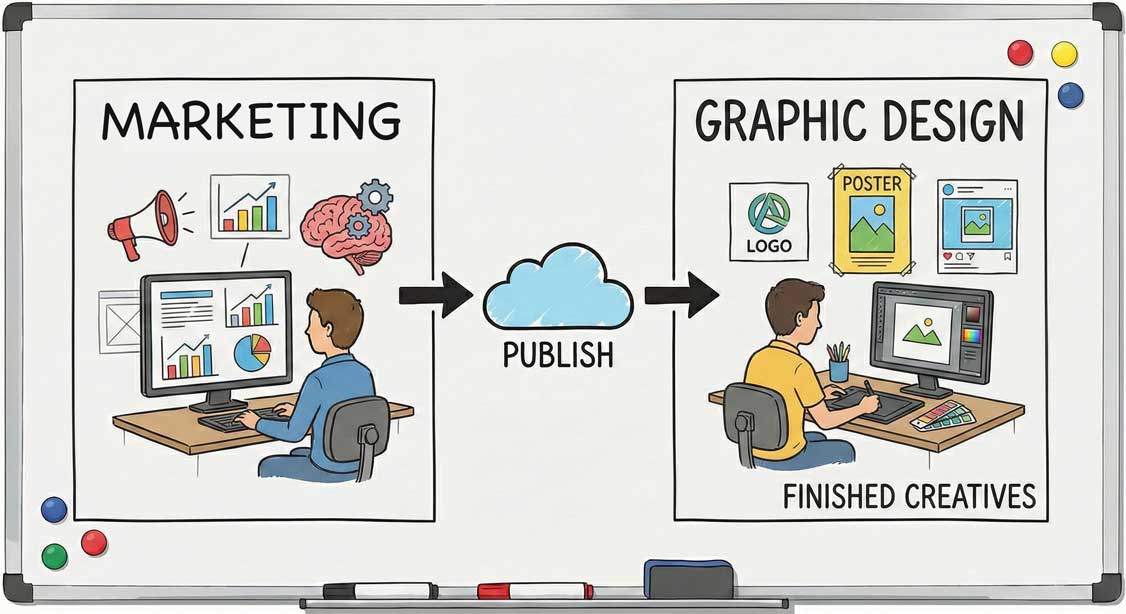
Graphic design education often emphasizes form, aesthetics, and conceptual development. These skills are essential. However, in professional practice, design decisions rarely exist in isolation. They are most often shaped - and funded - by marketing objectives. One of the most valuable but under-acknowledged skills I bring to web design education is a deep familiarity with the digital marketing ecosystem and how it directly influences design outcomes.
In professional settings, the majority of design work is funded through marketing budgets rather than standalone design allocations. Across agencies, in-house teams, and small businesses, it is common for 60-80% of web, branding, and digital design spending to originate from marketing departments. This reality has practical consequences for designers. Projects are evaluated not only on visual quality, but on performance, conversion, reach, and return on investment.
Students who are unaware of this context often struggle to understand why certain design decisions are prioritized over others. Marketing literacy helps explain why a homepage hierarchy favors clarity over novelty, why messaging sometimes overrides aesthetic restraint, and why usability testing may outweigh personal taste. Teaching this perspective does not diminish design; it clarifies its purpose.
Marketing research plays a decisive role in shaping professional design decisions. In many commercial projects, design direction is informed by analytics, user behavior data, A/B testing, keyword research, and demographic targeting. In practice, it is not unusual for a majority of major design choices - often well over half - to be influenced directly by marketing research or performance data. Designers who understand how to interpret this information are better positioned to contribute meaningfully rather than react defensively.
This knowledge is especially important in web design, where visual decisions are inseparable from measurable outcomes. Page layouts affect conversion rates. Typography influences readability and engagement. Color choices can alter click behavior. When students understand how marketing teams evaluate success, they begin designing with intention rather than decoration. They learn that constraints are not obstacles, but signals.
Digital marketing literacy also reshapes how students think about audiences. Rather than designing for a vague “user,” they learn to consider segmented audiences, intent, and context. Concepts such as buyer journeys, funnels, and touchpoints give students a clearer mental model of how people encounter and interact with design in real situations. This leads to work that is more focused, adaptable, and realistic.
Search engine optimization further demonstrates the intersection between marketing and design. Layout decisions, content structure, load speed, and accessibility all influence discoverability. Designers who understand SEO fundamentals are less likely to create visually impressive but practically invisible work. As AI-driven search and content retrieval systems become more prevalent, this integration becomes even more critical. Design choices increasingly affect not only human users, but automated systems that determine what content is surfaced at all.
This literacy also improves collaboration. Designers fluent in marketing concepts can communicate effectively with strategists, copywriters, and clients. They understand the language of metrics, timelines, and campaigns. This reduces friction and positions designers as strategic partners rather than purely visual contributors. In the classroom, this translates into students who are more confident presenting and defending their work using criteria that stakeholders actually value.
Importantly, teaching marketing awareness does not turn design education into advertising training. Instead, it preserves design integrity by grounding it in context. Students are still encouraged to explore form, voice, and experimentation -but they do so with an understanding of how their work functions in economic and organizational systems.
My experience has shown that students who grasp the relationship between design and marketing are better prepared for professional practice. They adapt more quickly, ask better questions, and produce work that aligns creative intention with measurable goals. In an industry where design is increasingly evaluated by performance, this understanding is not optional. It is a quiet but powerful advantage—one that helps students bridge the gap between the classroom and the realities of the digital economy.